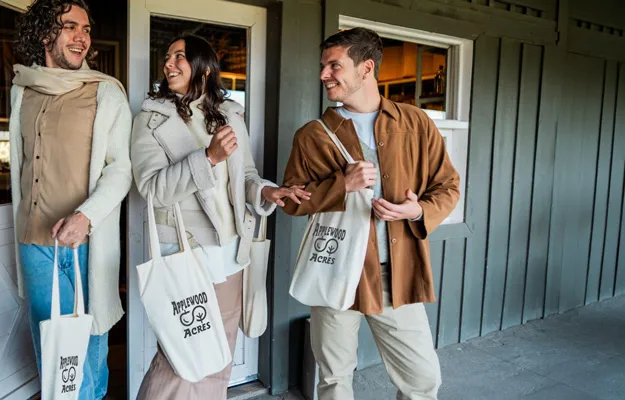
Custom bags for business merchandise

By Ross Bielema
Tips & FAQs
Read Time: 6 minutes
Posted: September 22, 2026
Key Takeaways:
- Custom bags deliver long-lasting brand exposure through everyday use.
- Choose bag materials based on your audience, budget and event goals.
- Tote bags, drawstrings and backpacks remain top picks for promotions.
- Creative designs and personalization help bags stand out and stay in use.
- Ordering samples and planning ahead can help ensure the perfect final product.
A great tote or backpack travels—to the grocery store, the gym, the office, the classroom—carrying your name everywhere it goes. That everyday usefulness is exactly why custom bags have become one of the most dependable ways to keep your brand in front of the people who matter. Whether you're outfitting a trade show booth, thanking donors, welcoming new students or handing out gifts to employees, the right logo bag turns ordinary errands into ongoing exposure. This guide covers everything you need to know before you order—from materials and costs to design, sustainability, samples and timelines.
What is a promotional bag?
A promotional bag is any bag—tote, drawstring, backpack, cooler or shopper—imprinted with an organization's name, logo or message, and then given away, sold or used as part of a larger campaign. The purpose goes well beyond carrying things. Because bags are handled in public, reused for months or years, and seen by dozens of people each time they leave the house, they function as one of the most cost-effective forms of moving advertising you can circulate. A single reusable shopper spotted at a farmers market or a busy conference hall reaches an audience far larger than the person actually holding it—every trip past a grocery checkout line, coffee shop, transit stop or office lobby puts your imprint in front of a fresh set of eyes. Industry research backs this up: ASI's Ad Impressions Study opens in new window estimates that a single $6 tote bag generates roughly 5,000 brand impressions over its lifetime—at a cost of about one-tenth of a cent each.
That reach makes bags valuable across nearly every setting. At events and trade shows, they collect literature and giveaways while quietly advertising the exhibitor whose imprint is on the side. Schools rely on them for orientation kits, spirit days, fundraisers and library programs. Nonprofits use them for donor thank-you gifts, awareness walks and volunteer appreciation. Businesses hand them out for product launches, employee onboarding and customer loyalty milestones. In each case, the bag does double duty. It's useful to the recipient and promotes the sender.
The lasting impression comes from that combination of visibility and utility. Custom bags with logo placement front and center reinforce your message every time the bag is picked up. And, because people tend to keep bags they genuinely find handy, your brand stays in rotation long after the event ends. A thoughtfully chosen bag signals that an organization pays attention to quality and details—an impression that carries over to how people perceive everything else you do.
What materials are commonly used for custom bags?
Material is the single biggest factor shaping how a bag looks, holds up and fits the occasion. The most common options have a clear sweet spot:
Canvas: Sturdy and structured, canvas totes stand up on their own and handle heavier loads. Their natural texture takes ink cleanly and projects durability and value, making them a favorite for bookstores, markets and keepsake gifts people actually reuse.
Cotton: Soft, breathable, and endlessly reusable, cotton totes strike a balance between affordability and quality. They're a go-to for schools, nonprofits, and any audience that appreciates a natural, washable bag they'll carry for years.
Non-woven polypropylene: The workhorse of the reusable category, non-woven fabric is affordable, tear-resistant and lightweight, which is why it dominates grocery totes, convention bags, and trade show giveaways where you need volume without sacrificing durability.
Paper: Clean, upscale and fully recyclable, kraft shoppers, gift bags and Euro totes bring a boutique feel to product purchases, corporate gifts and store branding. They photograph beautifully and pair well with tissue and ribbon for a premium presentation.
Plastic: Lightweight and water-resistant, poly totes and die-cut shopping bags are good for high-volume giveaways where price and quantity matter most. They print bright, hold their shape, and work well for retail packaging or large public events.
Choosing among them comes down to matching the material to the job. Durability requirements matter—a bag meant to haul textbooks or groceries needs more strength than one holding a few flyers. Appearance matters, too, since a rugged canvas tote communicates a very different message than a plastic shopper. And the setting sets the tone: retail and gifting lean toward paper and canvas, while mass giveaways at fairs and conferences favor plastic and non-woven styles that let you reach a big crowd affordably.
How much do custom bags typically cost?
Pricing for custom bags spans a wide range because so many variables feed into the final number. As a general rule, lightweight non-woven and plastic totes sit at the budget-friendly end, often just a dollar or two per piece at higher quantities, while structured canvas bags, insulated coolers and full-featured backpacks climb higher based on the materials and construction involved. Four factors drive the cost of nearly any order:
Material and construction. Simple poly and non-woven bags cost less than heavyweight canvas, laminated or padded styles.
Size and features. Larger bags, extra pockets, zippers, gussets and reinforced handles all add to the price.
Print method and imprint area. A one-color imprint on one side is the most economical option; full-color prints, multiple imprint locations and all-over designs raise the cost.
Order quantity. Unit price drops as volume rises, which is where per-piece savings really add up.
For a small business budget, non-woven totes and paper shoppers deliver strong brand impact without a large upfront investment, and low minimums help keep smaller runs realistic. When you're ordering in bulk for a conference, campaign or district-wide rollout, the economics shift in your favor—larger quantities lower the price per bag significantly, so a big giveaway can be surprisingly affordable per impression.
It's worth factoring value-added services into the picture too. Free design help from a dedicated art team means you won't pay extra to get your artwork print-ready, and the reassurance built into 4imprint’s 360° Guarantee®—which ensures certain value, on-time delivery, and complete satisfaction with the finished product—protects the money you invest. When you weigh those inclusions against the sticker price, the true value of an order often looks better than the line-item cost alone suggests.
What are the most popular types of custom bags for corporate events or promotional giveaways?
A handful of styles consistently outperform the rest for events and giveaways, each suited to a slightly different purpose:
Tote bags are the all-purpose champion. Roomy, flat-sided and easy to print on, they're perfect for trade show floors, conference welcome kits and retail gifting. Attendees use them to carry everything they collect, turning the show floor into a sea of walking billboards.
Drawstring bags are lightweight, cinch-close backpacks that shine at active events—fun runs, sporting matches, camps and campus giveaways. They're inexpensive enough to hand out in high volume and sporty enough that people keep wearing them.
Backpacks are the premium pick. Ideal for higher-value gifts, employee onboarding, executive events and student programs, they deliver the longest lifespan and the most day-to-day use, keeping your brand in view for years.
Reusable shopping bags appeal to conscientious-minded audiences and lend themselves beautifully to grocery-store visibility. Because they're given out week after week, they generate a sizable number of impressions for their modest cost.
Across all four styles, custom bags are favored for giveaways, conferences and trade shows because they combine reach with staying power. While some promos are designed for short-term use, a quality bag sticks around and stays in circulation. That longevity is what makes bags one of the highest-return items you can put in an attendee's hands, and it's why they show up in booth strategies and welcome kits year after year. That staying power extends to memory too: statistics show 90% of people who receive a promotional product opens in new window remember the brand name and 73% are more likely to do business with a brand that offers them.

90%
Statistics show 90% of people who receive a promotional product remember the brand name and 73% are more likely to do business with a brand that offers them.
How to create a logo for bags?
A logo that looks sharp on a business card doesn't automatically translate to fabric or paper, so a little preparation goes a long way. The goal is a clean, scalable mark that stays crisp whether it's printed small on a drawstring pouch or large across a canvas tote. Keep these principles in mind:
Favor simplicity. Bold shapes, clear text and a limited color palette reproduce far better than intricate detail. Thin lines and tiny type can fill in or fade once printed.
Design in vector format. Files like AI, EPS, or high-resolution PDF scale to any size without losing quality, which is exactly what bag printing requires. Low-resolution JPGs and screenshots often print blurry.
Plan your colors. Every additional ink color can affect cost, and colors read differently on natural cotton, kraft paper or colored non-woven fabric than they do on a white screen. Knowing your exact brand colors helps ensure consistency.
Consider contrast. A mark needs to pop against the bag color you choose, so pairing a light imprint with a dark bag (or vice versa) keeps your message legible.
If you're launching merchandise or building a cohesive retail identity, this is where getting the artwork right pays off most—your bag becomes an extension of your label, so the design has to feel polished and on-brand. The good news is that you don't have to navigate file formats and color decisions alone. Complimentary art assistance from an experienced design team will clean up, resize, recolor or even redraw your artwork and send back a free proof so you can see exactly how it will print before anything goes into production. That support takes the guesswork out of the process and helps your finished bags look every bit as professional as you imagined.
What are some creative ways to design and personalize custom bags for a brand?
Once your artwork is ready, the design possibilities open up quickly. Standing out in a room full of giveaways—or on a busy sidewalk—often comes down to a creative touch that makes people want to keep and use the bag. A few directions worth exploring:
Full-color prints. Instead of a single imprint color on one side, consider a full-color image for a bold look that reads as intentional and premium.
Eye-catching handles and accents. Contrasting handle colors, rope drawstrings, webbed straps or coordinated trim elevate a basic bag into something that feels sophisticated.
Unique shapes and silhouettes. Die-cut shoppers, gusseted totes, boxy coolers and structured backpacks each create a distinct footprint that helps your brand stand apart.
Personalization. Adding team titles, event dates or department labels turns a giveaway into a keepsake, and individualized bags dramatically increase how likely people are to hang onto them.
Thinking about your audience is what makes these choices work for your brand. Shopping online lets you tailor every detail to the group you're reaching. Schools might lean into spirit colors, mascots and student names for orientation kits. Nonprofits can print a mission statement or campaign tagline alongside the logo to reinforce their cause. Corporate clients often choose refined, minimalist designs in brand colors that feel appropriate for clients and executives alike. The same base bag can be dressed up or down to suit any occasion, which is what makes personalization such a powerful tool—one product, endless ways to make it unmistakably yours.
What are sustainable material options for custom bags that still allow for logo printing?
Sustainability has become a strong reason that organizations choose branded bags in the first place. A reusable bag naturally reduces reliance on single-use alternatives, and when it's partly made from responsible materials, that message becomes part of your brand story. In fact, the U.S. EPA opens in new window notes that a single reusable bag can replace hundreds—even thousands—of single-use bags over its lifetime. Several printable, reusable options are widely available:
Recycled materials. Bags made from a recycled material blend and recycled cotton give discarded material a second life while still offering a smooth, printable surface for your imprint.
Organic cotton. Organic production systems support soil health, reduce the use of harmful pesticides and fertilizers, and typically use less water. Organic cotton totes carry a natural, high-quality feel that appeals to audiences and takes ink cleanly.
Better Choices® non-woven bags. These reusable styles are designed with a more positive environmental impact in mind, pairing everyday durability with a smaller footprint—an easy upgrade for grocery totes and event giveaways.
None of these options is a compromise on branding. Each accepts a crisp imprint, so your colors and message come through just as clearly as they would on a conventional bag. That matters when you're ordering wholesale for a large program because sustainability and visibility work best together. A recycled or organic bag printed with your name doesn't just advertise your organization—it demonstrates your values in a tangible way. For schools teaching stewardship, nonprofits built around environmental missions, or companies with sustainability goals, choosing a responsible material sends a consistent message that reinforces everything your brand stands for.
How to get samples of custom bags before placing a larger wholesale order
Requesting a sample is one of the smartest steps you can take before committing to a large run. Photos and specs tell part of the story, but holding the actual bag lets you evaluate what really matters: the weight and feel of the material, the sturdiness of the handles and seams, the true color and how well the surface will carry your print. When you're planning wholesale quantities, that firsthand check helps protect you from surprises and gives you confidence that the finished product will meet expectations.
The process is refreshingly simple. You can request a sample to review before you order, giving your team a chance to compare styles side by side, test the size against what you plan to carry, and make sure the material suits your event or audience. Many buyers find that a single sample settles internal debates quickly because everyone can see and touch the real thing rather than guessing from a screen.
Free samples take the risk out of that evaluation, and they pair naturally with the reassurance already built into every order. Requesting a sample means you know exactly what item is coming, and the same guarantee that backs your purchase—covering delivery, value and your happiness with the result—means that, even after production, you're protected. Together, sample requests and 4imprint’s guarantee let you move forward with a big order knowing the outcome is certain rather than hoped for.
How long does it typically take to design and receive a batch of custom bags?
Turnaround depends on a few moving parts, but most standard bag orders move from art approval to delivery within a predictable window—commonly around 7–10 business days once your artwork is finalized and your proof is approved, plus shipping. Two factors have the most influence on that timeline:
Art approval. The clock on production really starts once you've reviewed and approved your proof. Having print-ready artwork and responding quickly to your proof keeps things moving; delays in approval are the most common reason an order takes longer than expected.
Order size and complexity. Larger quantities, multiple imprint colors, and intricate designs can require more production time than a simple one-color run.
When your deadline is tight, expedited options are available. Select styles ship with 24-hour rush service, so a last-minute event or an unexpected opportunity doesn't have to mean going without branded bags. Planning ahead is always ideal, but knowing a fast track exists provides valuable peace of mind.
For a deeper look at production windows on one of the most popular categories—including detailed timelines and rush possibilities—look at our turnaround time for custom tote bags with logo section. Whatever your timeline, on-time delivery is backed by the same promise that accompanies every order: If it doesn't arrive when it's supposed to, you won’t be charged. That certainty is what lets you commit to an event date without second-guessing whether your bags will be there.
Can companies order custom bags in small quantities, or is there a minimum order requirement?
Most custom bags do carry a minimum order quantity, but those minimums are typically low enough to keep branded bags within reach for organizations of every size. The exact figure varies by style: Simple non-woven totes often have modest minimums that suit a single classroom, a small fundraiser, or a boutique's retail counter, while more complex, brand-name backpacks and specialty styles may start at a lower count. Read our blog on minimum order quantities for tote bags for a deeper dive. At 4imprint, you don’t need to commit to thousands of pieces to get started.
That accessibility is good news for small businesses, startups and one-off events that don't need a warehouse full of inventory. A local shop can order just enough tote bags to gift with purchases; a nonprofit can outfit a small volunteer crew; and a school club can produce spirit bags for its members without overbuying. Low minimums mean you can match your order to your actual need.
At the same time, ordering in bulk unlocks the best per-piece pricing for districts, conferences, corporate rollouts and large campaigns—so the same product line scales comfortably from a few dozen to several thousand. Whether you're testing the waters with a small batch or supplying a major event, there's a flexible path that fits your quantity, your budget and your timeline. And a knowledgeable team is waiting to help you find the right style for your needs. And if you’re wanting more information, check out our post on how fast a bulk order of custom totes can be delivered.
Custom bags do a rare thing in promotional marketing: They blend genuine everyday usefulness with long-lasting brand visibility, all while flexing to fit any audience, budget or occasion. From choosing the right material and refining your design to sampling before you commit and hitting your deadline with room to spare, every decision along the way shapes how well your bags represent you. If you're ready to see what's possible, browse our custom tote bag options and start turning an everyday carryall into everyday exposure for your brand.

Ross Bielema
Ross Bielema is a seasoned SEO marketing specialist at 4imprint, based in Oshkosh, WI, a title he’s held for the past 16 years. He previously was a copywriter here, crafting everything from headlines and company letters to e-mails and faxes. Boosting web presence and organic ranking creatively for one of North America’s top promotional merchandise distributors comes easily because of his combined 38 years of journalism experience. This includes freelance writing for local media outlets such as the Shawano (WI) Leader newspaper, expanding his experience beyond digital marketing into broader content creation. Ross brings a unique blend of marketing acumen, content creation talent and community engagement to his work at 4imprint.
All marks are the property of 4imprint or their respective owners.